
Learn More About Dr. Kenner
Radio Talk Show Host
Books by Dr. Kenner
Media Appearances
Articles & Book Recommendations
Court Testimony: Expert Witness
Professional Associations
Professional Experience
Education
Non University Coursework & Seminars
Teaching Experience
Academic Appointment/License
Clinical Internship
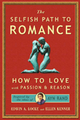 All quotes are from Ellen's and Ed's romance book:
The Selfish Path to Romance - How to Love With Passion and Reason
Buy now through Amazon
Table of Contents

Tweets by @SelfishRomance
The Rational Basis of Emotions
"The RATIONAL Basis" is a registered trademark of Dr. Ellen Kenner
Sara snaps at her husband. She then picks up a book that her two-year-old had left on the floor and tosses it with fury across the room. Her head is pounding and she can feel the tension coursing throughout her body. She looks in the mirror and bursts into tears. Sara is experiencing a raging storm of negative emotions. Her fists tighten with anger, her heart races with anxiety, her tears are evidence of sadness, her grit teeth are signs of frustration and anger. Her emotions seem to paralyze her. She finds it difficult to focus, to think.
Sara's experience is common. What can any of us do in such moments? Do you just have to let the emotions run their course? Do you try to get a moment's relief by guzzling down a can of beer, or by retreating into a troubled sleep? Do you call a friend and complain about how trapped and unhappy you feel, adding that there is nothing you can do about it? Is that true? Is there nothing you can do? Are your emotions outside your control? In one sense yes. But in a more important sense - no! Emotions are automatic responses. In that sense, they are outside your immediate conscious control, like your eye blink response. But emotions are automatic responses of what? . Let's look at that - because that is the crucial question. They are automatic responses of your underlying thoughts. Let's see how.
Imagine that Sara asks herself, ``What emotions am I feeling?" Her answer is ``I'm feeling angry and very anxious." Notice, instead of just experiencing her emotions, the tight fist, the racing heart, she named her emotions. That's the first step in gaining some control over your emotions: Identify your emotions in words. Instead of sinking into a glob of emotions and feeling the bodily counterpart (racing heart, clenched fist, headaches, upset stomach), Sara identified each emotion she was feeling. ``I feel angry! I feel anxious! I feel depressed!". The more she can make her internal psychological experience explicit, the easier it is for her to understand her moods and gain control.
Try this experiment: focus on a strong emotion you recently felt. It can be a positive or negative emotion. Try to re-create it. Identify your emotion in words: I am feeling _______. (e.g., anxious, sad, guilty, angry, happy, elated). Next, it helps to know that every emotion has a specific meaning that you can rationally understand. Learning the following will help you decode your emotions:
- Happiness signifies that you have achieved an important value (e.g., Tara Lapinski's radiant joy when she landed her triple jumps and her screams of delight when she won the Olympic Gold Medal).
- Depression or sadness signify a loss (e.g., loss of a friendship, loss of a job, loss of your own good self-image, loss of a treasured possession).
- Anxiety signifies that you are feeling out of control (e.g., you don't know what you will do for a living, you don't know how to manage your chaotic family).
- Guilt signifies that you have acted against your own values (e.g., you lied to your spouse).
- Anger signifies that you are experiencing an injustice (e.g., your child stole money from you).
This is just a sampler of emotions. Knowing that each emotion signifies a unique theme, you can then decode your emotions. If you are feeling sad, ask yourself:
In what specific manner am I experiencing a loss? If my sadness could speak it would say _______. Perhaps Sara's sadness would say ``I feel the loss of my marriage…my husband hates me".
Next, see if your feelings accurately represent the true situation. For Sara perhaps they do, perhaps her husband is filing for divorce. But it is also possible that her husband adores her, realizes that she is currently under tremendous stress and is giving her some distance. Sara's gut emotional response, that her husband hates her and wants a divorce, may be seriously off-base.
You can rationally understand your emotions. This skill is essential for your happiness.
To summarize: Identify your emotions in words. Know what each emotion signifies. Ask yourself: ``If my emotion (sadness, anxiety, joy) could speak, it would say ____." Decode your emotions into the underlying thoughts. Finally, give these thoughts a reality check. Is your emotion, your automatic response to your underlying thoughts, an accurate appraisal of the situation or is it based on distorted thinking and scanty evidence? Use your mind, your ability to question and look for actual evidence, to assess your emotion. Emotions are not mystical -they are rationally understandable. Learn to understand and enjoy your emotional life.
